


At GNEE, we specialize in the production and global supply of high-performance NM400 wear resistant plate and NM300TP steel plate, designed for the most demanding industrial environments.
As a professional manufacturer, we understand that selecting the right abrasion resistant steel plate is critical to extending equipment life and reducing maintenance costs.
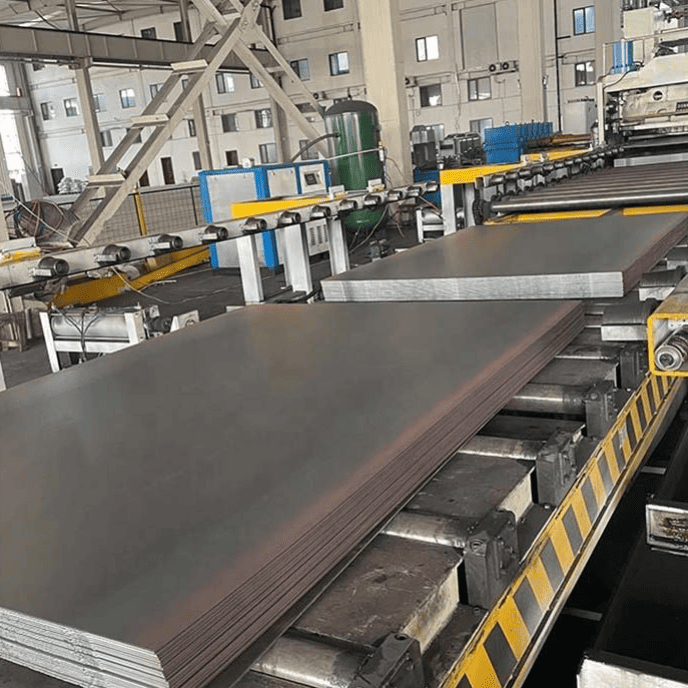
NM400 wear resistant plate
Whether your application requires the extreme hardness of NM400 steel or the superior impact resistance of NM300TP toughness plate, our factory-direct solutions ensure consistent quality, strict heat treatment control, and full certification.
Understanding the differences between NM300TP vs NM400 wear resistant plate is essential for optimizing performance in mining, construction, and cement industries.
Hardness and Microstructure Comparison of NM300TP vs NM400 Steel
The key difference between NM300TP steel and NM400 wear resistant plate lies in hardness and microstructure.
- NM400 Steel: Designed for high-abrasion environments, featuring a hardness range of 370–430 HBW. Its microstructure is predominantly a dense martensitic structure, providing a shield against "plowing" from abrasive materials.
- NM300TP Steel: Features a lower hardness range of 270–340 HBW. However, the "TP" designation stands for "Toughness Plate," indicating a microstructure engineered to retain ductility and resist brittle fracture under high-energy impact.
Mechanical Properties of NM300TP vs NM400 Steel
| Property | NM300TP Steel | NM400 Wear Resistant Plate |
|---|---|---|
| Hardness (HBW) | 270 – 340 | 370 – 430 |
| Yield Strength | ≥ 800 MPa | ≥ 1000 MPa |
| Tensile Strength | ≥ 1000 MPa | ≥ 1200 MPa |
| Elongation | ≥ 14% | ≥ 10% |
| Impact Energy (-20°C) | ≥ 24 J | ≥ 21 J |
| Workability | Excellent | Moderate |
NM400 wear resistant steel plate offers higher strength and wear life, while NM300TP steel plate provides better ductility and impact resistance.
Chemical Composition Comparison of NM300TP vs NM400 Steel
The performance differences between NM300TP steel and NM400 wear resistant plate come from alloy design:
| Element | NM300TP (%) | NM400 (%) | Key Difference |
|---|---|---|---|
| C | ≤ 0.20 | ≤ 0.25 | NM400 higher hardness |
| Si | 0.15 – 0.55 | ≤ 0.70 | NM400 stronger |
| Mn | 1.20 – 1.60 | ≤ 1.60 | Similar |
| Cr | 0.80 – 1.20 | ≤ 1.40 | NM400 better wear resistance |
| Mo | 0.10 – 0.30 | ≤ 0.50 | NM400 higher hardenability |
| Nb | 0.02 – 0.05 | - | NM300TP improves toughness |
| S | ≤ 0.005 | ≤ 0.010 | NM300TP better weldability |
The alloying elements are precisely controlled at the GNEE factory to achieve the desired balance of hardness and weldability. NM400 steel utilizes higher Carbon and Chromium to achieve its wear resistance, while NM300TP introduces Niobium (Nb) for grain refinement.
A common industry mistake is assuming that higher hardness is always better. In the battle of NM300TP vs. nm400 wear resistant plate, the environment dictates the winner:
- The Case for NM400: If your equipment deals with sliding abrasion-such as sand, gravel, or coal sliding down a chute-the high surface hardness of nm400 steel is indispensable. It prevents the material from "digging" into the plate.
- The Case for NM300TP: If your equipment faces high-impact shocks-such as large rocks falling into a truck bed-NM400 might develop micro-cracks due to its brittleness. NM300TP acts as a "forgiving" material, absorbing the kinetic energy without structural failure.
Processing Performance of NM300TP vs NM400
GNEE provides custom fabrication services, and our workshop data shows distinct differences in how these materials handle processing:
- Weldability: NM300TP has a lower carbon equivalent (Ceq), making it easier to weld with standard procedures. NM400 steel requires more stringent pre-heating and cooling controls to prevent cold cracking.
- Bending: Due to higher elongation, NM300TP is the preferred choice for components requiring tight radii. nm400 wear resistant plate is stiffer and requires larger bending forces and radii.
- Machining: NM300TP allows for faster drilling and milling with less tool wear compared to the abrasive nature of NM400.
Applications of NM300TP vs NM400
| NM300TP Steel Plate | NM400 Wear Resistant Plate |
|---|---|
| Dump truck bodies | Mining buckets |
| Excavator floors | Crusher liners |
| Concrete mixers | Chute liners |
| Loader edge protection | Conveyor wear plates |
The choice between NM300TP steel and NM400 wear resistant plate is a balance between impact resistance and abrasion resistance.
- NM400 steel plate → Longer life in high-friction environments
- NM300TP steel plate → Better durability under impact conditions
Selecting the right abrasion resistant steel plate can significantly reduce downtime and maintenance costs while improving equipment efficiency.
If you are evaluating NM300TP vs NM400 wear resistant plate, GNEE is ready to support your project with professional material selection and factory-direct supply. We provide high-quality NM400 steel plate and NM300TP steel plate with strict quality control, stable performance, and full certification.
Our team can assist with custom sizes, precision cutting, and application-based recommendations to ensure you choose the most suitable wear resistant steel solution.
Whether your priority is abrasion resistance or impact toughness, we help you achieve the best balance between cost and performance.
Contact us today to get a fast quotation or request a sample, and let GNEE help you improve equipment lifespan and reduce long-term operating costs.
Contact now to get NM400 steel plate Quote
Is NM400 the same as Hardox 400?
No. they are comparable in nominal hardness band (~400 HBW) but Hardox® 400 is a branded product with controlled chemistry, guaranteed toughness and detailed mill documentation from SSAB. NM400 is a Chinese standard grade with similar hardness but variable mill-to-mill properties. Always specify required testing and acceptance criteria, not only grade name.
Can NM400 be welded to structural steels?
Yes with matched filler and appropriate preheat/thermal control. Avoid high heat input and verify consumables with the supplier's welding instructions.
How do I select between NM400 and a harder NM450 / NM500?
Choose by wear mode: for abrasive sliding wear NM400 often suffices; for extremely abrasive, long-life needs select NM450/NM500 but expect increased cost and reduced formability.
Is NM400 suitable for bucket liners and dump bodies?
Yes. widely used for these applications; ensure weldability and thickness suit the application.
Can NM400 be flame cut and drilled?
Yes; use standard industrial cutting methods but be mindful of hardened surface causing additional tool wear.
How should NM400 be stored and handled?
Store flat on timber, avoid edge damage, keep clean and protected to avoid contamination of welding surfaces.