


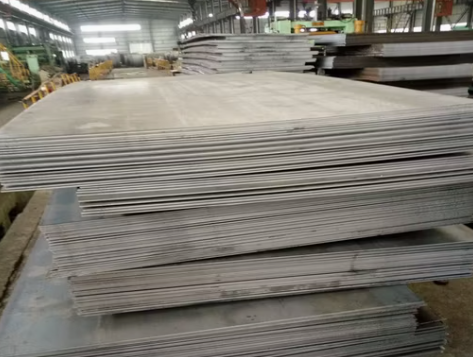
ASTM A515 Grade 65 is a carbon steel plate designed for moderate to high‑temperature pressure vessels and boiler components. It offers good strength, weldability, and stable performance under heat and pressure. Widely used in power generation, petrochemical, and general pressure vessel applications, it provides a cost‑effective choice without sacrificing reliability or durability.
A515 Grade 65 pressure vessel steel chemical composition %
| Grade | Thickness | C max | Mn max | P max | S max | Si |
| A515 Grade 65 | t≤25 | 0.28 | 0.90 | 0.025 | 0.025 | 0.15-0.40 |
| 25﹤t≤50 | 0.31 | |||||
| 50﹤t≤100 | 0.33 | |||||
| 100﹤t | 0.33 |
A515 Grade 65 pressure vessel steel Mechanical properties
| Grade | Yield strength ReH MPa min | Tensile strength Rm MPa | Elongation A% min | |
| 200mm | 50mm | |||
| A515 Grade 65 | 240 | 450-585 | 19 | 23 |

Applications
Boiler manufacturing: Steam drums and other core pressure-bearing components
Petrochemical industry: Medium-pressure hydrogenation refining reactors, catalytic cracking regenerators, tube-and-shell heat exchanger shells, LPG/propylene storage tanks
Power generation industry: Steam pipelines and heat recovery system components (thermal power plants, nuclear power auxiliary equipment)
General pressure vessel fabrication: Separators, spherical tanks, gas storage tanks (chemical, metallurgical industries)
High-pressure pipeline manufacturing: Spiral welded pipes and straight seam welded pipes for medium-pressure steam transportation
 Application Conditions
Temperature range: Typically -29°C to 345°C (long-term service under high temperature)
Pressure range: Suitable for medium to high pressure scenarios (3-8MPa, depending on specific equipment)
Medium compatibility: Resistant to high-temperature steam, LPG, propylene and other common industrial media
Welding requirement: Adaptable to common welding processes (SMAW, GMAW, etc.) without strict preheating in most cases
Service environment: Suitable for industrial sites such as power plants, petrochemical plants, and metallurgical factories
Why Choose Us
You can get the perfect material according to your requirement at the least possible price.
We also offer Reworks, FOB, CFR, CIF, and door to door delivery prices. We suggest you to do deal for shipping which will be quite economical.
The materials we provide are completely verifiable, right from raw material test certificate to the final dimensional statement.(Reports will show on requirement)
We guarantee to give a response within 24hours(usually in the same hour)
You can get stock alternatives, mill deliveries with minimizing manufacturing time.
We are fully dedicated to our customers. If it will not possible to meet your requirements after examining all options, we will not mislead you by making false promises which will create good customer relations.
Contact us at beam@gneesteelgroup.com for pricing, technical support, or customized solutions. We are always ready to support your project.
How does A515 Grade 65 perform in corrosive environments?
A515 Grade 65 is a carbon steel and has limited corrosion resistance compared to stainless steels or alloy steels. It may require protective coatings, linings, or cathodic protection when used in corrosive environments such as those containing acids, salts, or moisture. In mildly corrosive or dry environments, it can perform adequately with proper painting or surface treatment. For severe corrosion, higher-alloy materials are preferred.
What is the maximum allowable stress for A515 Grade 65?
The maximum allowable stress for A515 Grade 65 is determined by ASME Section VIII based on temperature and plate thickness. At room temperature, it is typically around 17 ksi for plates up to 1.5 inches thick, decreasing at higher temperatures. These values ensure that the material operates safely within its elastic range, preventing plastic deformation and failure under pressure and thermal loads.
What is the fatigue strength of A515 Grade 65?
The fatigue strength of A515 Grade 65 depends on factors such as surface finish, weld quality, and operating temperature. Generally, it has an endurance limit of around 20 to 25 ksi for reversed bending at room temperature. In pressure vessel applications, fatigue analysis is critical for components subjected to cyclic loading, such as heat exchangers or vessels with frequent start-up and shutdown cycles.
Can A515 Grade 65 be formed into complex shapes?
Yes, A515 Grade 65 can be formed into various shapes using standard fabrication methods such as rolling, bending, and press forming. Its ductility and moderate strength allow it to be shaped without excessive cracking or springback. Thicker plates may require higher forming forces and preheating to reduce residual stresses and improve formability. Proper forming practices help maintain the material's mechanical properties and structural integrity.
What is the typical hardness of A515 Grade 65?
A515 Grade 65 typically has a Brinell hardness range between 137 and 197 HB, depending on the heat treatment and thickness. This hardness level indicates good strength and toughness balance, suitable for pressure vessel service. Higher hardness values may be achieved with quenching and tempering, but this is not standard for A515 grades, which are usually supplied in the as-rolled or normalized condition.
What are the storage and handling recommendations for A515 Grade 65 plates?
A515 Grade 65 plates should be stored in a dry, covered area to prevent rust and corrosion. Plates should be elevated off the ground using wooden or steel supports to avoid moisture accumulation. During handling, care should be taken to prevent surface damage, scratches, or gouges, which can act as stress raisers. Proper lifting equipment, such as slings or clamps, should be used to avoid deformation of thin plates.
What non-destructive testing is applied to A515 Grade 65?
A515 Grade 65 plates commonly undergo ultrasonic testing (UT) to detect internal flaws such as laminations or inclusions. Visual inspection (VI) is performed to check surface quality, and magnetic particle inspection (MPI) or liquid penetrant inspection (LPI) may be used to detect surface cracks, especially in welded areas. These tests ensure the material meets the quality requirements of ASTM and ASME standards.
What is the lead time for A515 Grade 65 plates?
Lead times for A515 Grade 65 plates vary depending on the producer, order size, and thickness. Standard thicknesses are often available from stock with short lead times, while custom sizes or thicker plates may require several weeks of production time. Factors such as heat treatment requirements, testing, and certification can also affect delivery schedules, so it is important to consult suppliers for specific lead time estimates.
What are the cost considerations for A515 Grade 65?
A515 Grade 65 is generally more cost-effective than alloy steels or stainless steels, making it a popular choice for pressure vessels. Prices depend on factors such as plate thickness, quantity, heat treatment, and testing requirements. Thicker plates and those requiring additional processing, such as quenching and tempering or ultrasonic testing, tend to cost more. Bulk orders may qualify for volume discounts from suppliers.
What are the future trends for A515 Grade 65 usage?
The use of A515 Grade 65 is expected to continue in traditional pressure vessel applications, particularly in boilers and heat exchangers. However, there is a growing trend toward using higher-strength and corrosion-resistant materials in demanding environments, which may reduce its market share in some sectors. Advances in steelmaking technology may lead to improved versions of A515 with better toughness or weldability, ensuring its relevance in future pressure vessel designs.