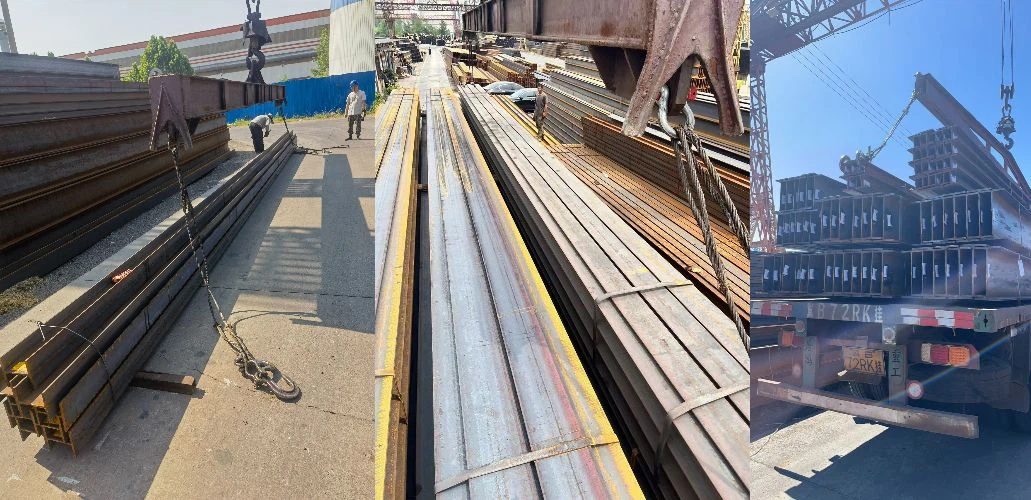
The "H" in H-beams refers to the cross-sectional shape resembling the capital letter H. These are wide-flange structural members with:
Parallel flange surfaces
Equal or near-equal width and depth
Thicker web than I-beams
Key Characteristics:
Flange width ≥ 75% of section height
Uniform thickness throughout flanges
Designated as "H" in US standards, "HE" in Europe
European standards use prefixes to denote proportions:
| Prefix | Flange Ratio | Example | Typical Use |
|---|---|---|---|
| HEA h type beam | Medium flange | HEA200 | Beams |
| HEB steel h profile | Wide flange | HEB200 | Columns |
| HEM structural steel beam | Extra wide | HEM200 | Heavy loads |
What is the structural importance of H-beam?
Advantages Over I-Beams
30-50% Higher Bending Resistance
Wider flanges increase section modulus (Z)
Better Column Stability
H-sections resist buckling 25% better than I-sections
Easier Connections
Parallel flanges simplify bolted/welded joints
Load Capacity Comparison
| Section | 200mm Depth | Moment Capacity |
|---|---|---|
| H-beam | HEB200 | 570 kN·m |
| I-beam | IPE200 | 390 kN·m |
Global Standards for H-Sections
1. American Standards (ASTM A6)
W-shapes: Equivalent to H-beams (W8×31)
HP-shapes: Bearing piles with equal flange/width
2. European Standards (EN 10025)
HEA/HEB/HEM: Metric H-sections
IPE: I-beams (not H-sections)
3. Asian Standards
JIS H-beams: Japanese standards
GB/T 11263: Chinese H-beams
| Model Number |
Q235B/C/D Q345B/C/D/E Q390B/C/D/E Q420B/C/D/E Q460/C/D/E Q500/C/D/E SS400 SM490A/B SN400A/B SN490B S235JR/J0 S275JR/J0/J2 S355JR/J0/J2 S355K2 S450J0 S355M/L S460M S355J0WP/J2WP S355J0W/J2W/K2W |
| Application | Industry/Chemical Equipment |
| Welding Line Type | Welding |
| Processing Service | Bending, Punching, Cutting, Moulding |
| Length | 6000mm 9000mm 12000mm or Customized |
| Technique | Hot Rolled Cold Rolled |
| Payment terms | L/C T/T (30%DEPOSIT) |
| Process method | Standard |