


Q355 steel is a Chinese low-alloy, high-strength structural steel, developed as an improvement over Q345 steel. It is widely used in construction, machinery, bridges, offshore structures, and other applications requiring enhanced strength and durability.
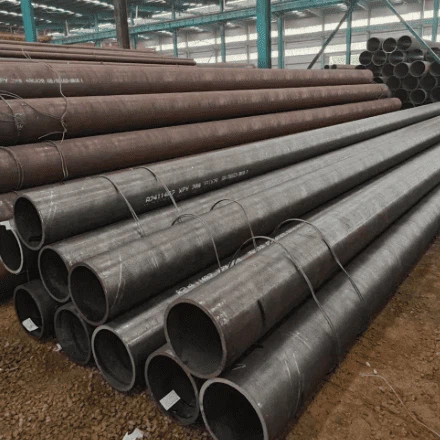
Minimum Yield Strength: 355 MPa (vs. 345 MPa for Q345)
High Strength, Good Plasticity, and Weldability
Applicable Standards: GB/T 1591-2018
Variants of Q355 Steel
Q355 steel is classified into B, C, D, and E grades, distinguished primarily by impact test temperatures and slight differences in chemical composition:
| Grade | Impact Test Temp | Key Features |
|---|---|---|
| Q355B | 20°C | Standard structural applications; good weldability and formability |
| Q355C | 0°C | Higher strength and hardness; suitable for heavier loads |
| Q355D | -20°C | Enhanced mechanical properties; high toughness and impact resistance |
| Q355E | -40°C | Excellent low-temperature performance; ideal for cold environments |
Q355A exists but is generally not impact-tested.
Chemical Composition (Typical)
| Element | Q355B (%) | Q355C (%) | Q355D (%) | Q355E (%) |
|---|---|---|---|---|
| C | 0.24 | 0.20 | 0.20 | 0.18 |
| Si | 0.55 | 0.55 | 0.55 | 0.50 |
| Mn | 1.60 | 1.60 | 1.60 | 0.90–1.65 |
| P | 0.035 | 0.03 | 0.025 | 0.025 |
| S | 0.035 | 0.03 | 0.025 | 0.020 |
| Cr | 0.30 | – | – | 0.30 |
| Ni | 0.30 | – | – | 0.50 |
| Cu | 0.40 | – | – | 0.10 |
| N | 0.012 | 0.012 | – | 0.015 |
Variations exist depending on application requirements and production process.
Mechanical Properties
| Property | Q355B | Q355C | Q355D | Q355E |
|---|---|---|---|---|
| Yield Strength (≤16 mm) | 355 MPa | – | 265 MPa | 355 MPa |
| Tensile Strength | 470–630 MPa | – | 450–600 MPa | 470–630 MPa |
| Elongation | 17–22% | – | 17–20% | 22% |
| Impact Energy | 34J at 20°C | 34J at 0°C | 34J at -20°C | 27J at -40°C |
International Equivalents
| Q355 Grade | ASTM | EN / EU | JIS / Japan |
|---|---|---|---|
| Q355B | A572 Gr 50 | S355JR | SM490B |
| Q355C | – | S355J0 | SM490C |
| Q355D | – | S355J2 | – |
| Q355E | – | – | – |
While considered equivalents, slight differences in chemical composition and mechanical properties exist. Always consult relevant standards before substitution.
Key Features
High Strength: Suitable for heavy-load structural applications.
Good Weldability: Compatible with arc welding, gas welding, and resistance welding.
Excellent Formability: Can be shaped into beams, columns, pipes, and complex structures.
Enhanced Toughness: Resists brittle fracture under dynamic loads.
Ductility: Can be deformed without failure.
Impact & Low-Temperature Resistance: Especially in Q355D/E variants.
Corrosion & Weather Resistance: Some variants tolerate harsh environments; further treatment can improve protection.
Applications
Structural beams, columns, and framework for buildings and bridges
Offshore platforms and marine structures
Heavy machinery and industrial equipment
Pipelines and pressure vessels in chemical and petrochemical industries
Cold-environment applications (Q355E)
Comparison: Q345 vs Q355
| Property | Q345 | Q355 |
|---|---|---|
| Yield Strength | 345 MPa | 355 MPa |
| Tensile Strength | 470–630 MPa | 470–680 MPa |
| Toughness | Good | Enhanced |
| Applications | Standard structures | High-strength structures, cold environments, heavy loads |
Q355 offers higher strength and better toughness, making it suitable for more demanding structural applications.
