


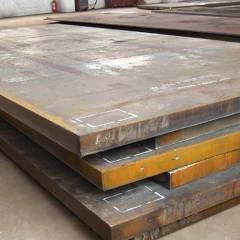
A537 Class 3 refers to a specific grade of heat-treated carbon-manganese-silicon steel plate (ASTM A537/ASME SA537) designed for fusion-welded pressure vessels, offering higher strength through quenching and tempering, suitable for moderate-temperature services like boilers, tanks, and heat exchangers, with good toughness and weldability, often specified with a minimum yield strength of 55 ksi.
Chemical Composition:
| Steel Grade | Thickness (mm) |
ASTM A537 Chemical composition %. | ||||||||
|---|---|---|---|---|---|---|---|---|---|---|
| C. max |
Si | Mn | P. max |
S. max |
Cu. max |
Ni. max |
Cr. max |
Mo. max |
||
| A537 Class3 | - | 0.24 | 0.13-0.55 | 0.64-1.46 | 0.035 | 0.035 | 0.38 | 0.28 | 0.29 | 0.09 |
Mechanical Property:
| Steel Grade | Thickness | Yield | Tensile | Elongation |
|---|---|---|---|---|
| A537 CLASS3 | 8-65 | 380 | 550-690 | 22 |
| 66-100 | 345 | 515-655 | 22 | |
| 101-150 | 275 | 485-620 | 20 |
Key Applications
Oil & Gas:
A537 Class 3 is widely used in the oil and gas sector for building pressure vessels, storage tanks, separators, and piping systems. These components often operate under high pressure and temperature, handling crude oil, natural gas, and various hydrocarbon fluids. The steel's combination of strength and toughness makes it suitable for both onshore and offshore installations, where reliability and resistance to brittle fracture are essential for safe and continuous operation.
Petrochemical Industry:
In petrochemical plants, A537 Class 3 is employed in the fabrication of reactors, process tanks, and a variety of processing equipment. These units are involved in reactions and separation processes that subject the material to cyclic loading, thermal stress, and corrosive environments. The steel's ability to maintain its mechanical properties at elevated temperatures makes it a preferred choice for ensuring long service life and minimizing downtime in critical production facilities.
Power Generation:
Within the power generation industry, A537 Class 3 is used for components in boilers and steam systems, including pressure parts and heat-transfer surfaces. These applications require materials that can withstand high-pressure steam and repeated thermal cycling. The steel's good creep resistance and toughness help ensure the structural integrity of boiler sections and associated equipment, contributing to the overall efficiency and safety of power plants.
Chemical Processing:
For chemical processing facilities, A537 Class 3 is utilized in the construction of tanks and vessels for moderate-pressure storage and handling of various chemicals. These vessels may be exposed to a range of temperatures and potentially corrosive media, depending on the specific process. The steel's balanced properties make it suitable for storing both liquid and gaseous chemicals in applications
For more details about GNEE's steel products, contact us at beam@gneesteelgroup.com. We look forward to working with you.
What is ASTM A537?
The ASTM A537 specification is the Standard Specification for Pressure Vessel Plates, Heat-Treated, Carbon-Manganese-Silicon Steel used in the applications of fusion welded pressure vessels and structures.
What is the typical heat treatment for A537 Class 3?
A537 Class 3 is typically supplied in the normalized and tempered condition. Normalization refines the grain structure and improves toughness, while tempering reduces hardness and residual stresses, resulting in a good combination of strength and ductility.