


H-shaped steel beams (H-beams) and IPE beams are essential structural elements in modern steel construction. Their applications range from residential buildings and industrial plants to bridges and heavy machinery.
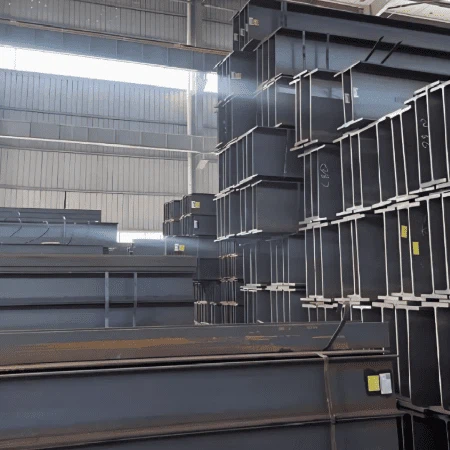
Understanding the material properties, mechanical performance, and suitable applications of these beams is crucial for engineers, architects, and project managers. This guide compares Q235 and Q345 H-beams with IPE beams, offering practical insights for construction projects.
1. Q235 H-Beam for Small Bridge Construction
Q235 H-beam is highly suitable for small bridge construction, including pedestrian bridges, bicycle bridges, and light vehicle bridges (cars, not heavy trucks). Q235 is a plain carbon steel with a minimum yield strength of 235 MPa and good ductility, providing sufficient load-bearing capacity for typical small bridge loads. Its H-shaped cross-section ensures excellent rigidity and reduces deflection over spans of 6–8 meters, commonly found in small bridges, while ensuring structural stability.
Additionally, Q235 H-beams offer excellent weldability, enabling easy connection to bridge piers and support components. Compared to higher-strength steels like Q345, Q235 is more cost-effective, helping to control budgets. To ensure durability in outdoor conditions, anti-corrosion treatments such as hot-dip galvanizing are recommended.
2. Q345 H-Beam for Large Steel Construction
Q345 H-beam is an ideal choice for large steel construction projects, including industrial plants, warehouses, and large bridges. Q345 is a low-alloy, high-strength steel with a minimum yield strength of 345 MPa, significantly higher than Q235. This allows it to support heavy loads, including industrial machinery, large storage tanks, and conveyor systems.
Its H-shaped cross-section provides exceptional rigidity, reducing deflection over long spans (10+ meters) and creating open, unobstructed workspaces.
Q345 also offers excellent toughness, impact resistance, and weldability, making it suitable for heavy-duty applications like main structural frames, overhead crane supports, and bridge main beams. Although Q345 H-beam is 10–15% more expensive than Q235 H-beam, its higher strength and efficiency justify the cost for heavy-load projects.
3. IPE Beams vs. H-Beams
IPE beams, commonly used in European steel construction, differ from H-beams in cross-sectional design, load-bearing capacity, and typical applications:
IPE Beam: Narrow flanges, taller and thinner web. Lightweight design with good bending resistance, suitable for light to medium-load applications such as floor joists, wall supports, or roof trusses. Example sizes: IPE 80 (80×46×3.8 mm), IPE 100 (100×55×4.1 mm), IPE 120 (120×64×4.4 mm).
H-Beam (Wide-Flange): Wider, thicker flanges and thicker web, offering higher load-bearing capacity and torsional strength. Suitable for heavy-load applications such as industrial building frames, bridge main beams, and heavy machinery supports.
Price and Material Efficiency: IPE beams use less steel per meter and are 15–25% cheaper than H-beams of the same Q235 grade, making them cost-effective for light to medium-load projects. H-beams are necessary for heavy-duty applications due to their superior load capacity.
4. Load-Bearing Capacity Comparison
The yield strength difference between Q345 and Q235 directly affects load-bearing capacity:
Q235 H-beam (200×200×9 mm) can handle ~7 kN/m over a 6-meter span.
Q345 H-beam (same size) can handle ~10.5 kN/m-a 40–50% increase in load capacity.
This makes Q345 preferable for heavy-load projects, including industrial plant main frames and bridge structures, while Q235 is adequate for moderate-load applications, such as small residential buildings and light bridges.
5. Applications Across Construction Types
| Beam Type | Material | Suitable Applications |
|---|---|---|
| Q235 H-Beam | 235 MPa yield | Small bridges, residential/commercial buildings, light industrial projects |
| Q345 H-Beam | 345 MPa yield | Large industrial plants, heavy machinery supports, main bridge beams |
| Q235 IPE Beam | 235 MPa yield | Residential floor joists, interior wall frames, light commercial ceilings, bridge sidewalks |
| Q345 IPE Beam | 345 MPa yield | Moderate-load industrial mezzanines, light machinery platforms |
Special Use Cases:
Q235 H-beam can be used in moderately seismic-prone areas, but may require larger sections or additional bracing.
Q345 IPE beams provide a balance of strength and reduced weight for industrial mezzanines spanning 5–7 meters, handling loads of 500–800 kg/m².
6. Anti-Corrosion Treatments
For bridge construction or outdoor applications, protective coatings are essential:
Hot-Dip Galvanizing: 20–30 years protection, ideal for harsh environments.
Epoxy Coating: Chemical-resistant, lasts 15–20 years for mild inland conditions.
Zinc-Rich Primer + Anti-Rust Paint: Affordable, lasts 8–12 years, easy to maintain.
Combination Treatment: Hot-dip galvanizing + epoxy for extreme conditions (coastal or industrial areas).
7. Manufacturing and Lead Time
H-Beams Manufacturing: Steel billets are heated, rolled into H-sections, then cooled, straightened, cut, and finished to ensure dimensional accuracy and mechanical properties. Wider flanges and parallel surfaces provide optimal bending resistance.
Lead Time: Standard Q235 IPE/H-beams usually ship within 2–5 weeks. Custom lengths or large quantities may extend to 4–5 weeks.
Q235 H-Beams: Cost-effective, suitable for moderate loads, small bridges, residential and light industrial applications.
Q345 H-Beams: High-strength, durable, ideal for heavy-load projects, large spans, and industrial structures.
IPE Beams: Lightweight, cost-efficient, suitable for secondary structural elements or light-load projects.
Selecting the appropriate beam depends on load requirements, span, structural design, budget, and environmental conditions. Proper anti-corrosion treatment and quality inspection ensure long-term performance and safety.
